Why “Off-the-Shelf” Themes Limit Scaling
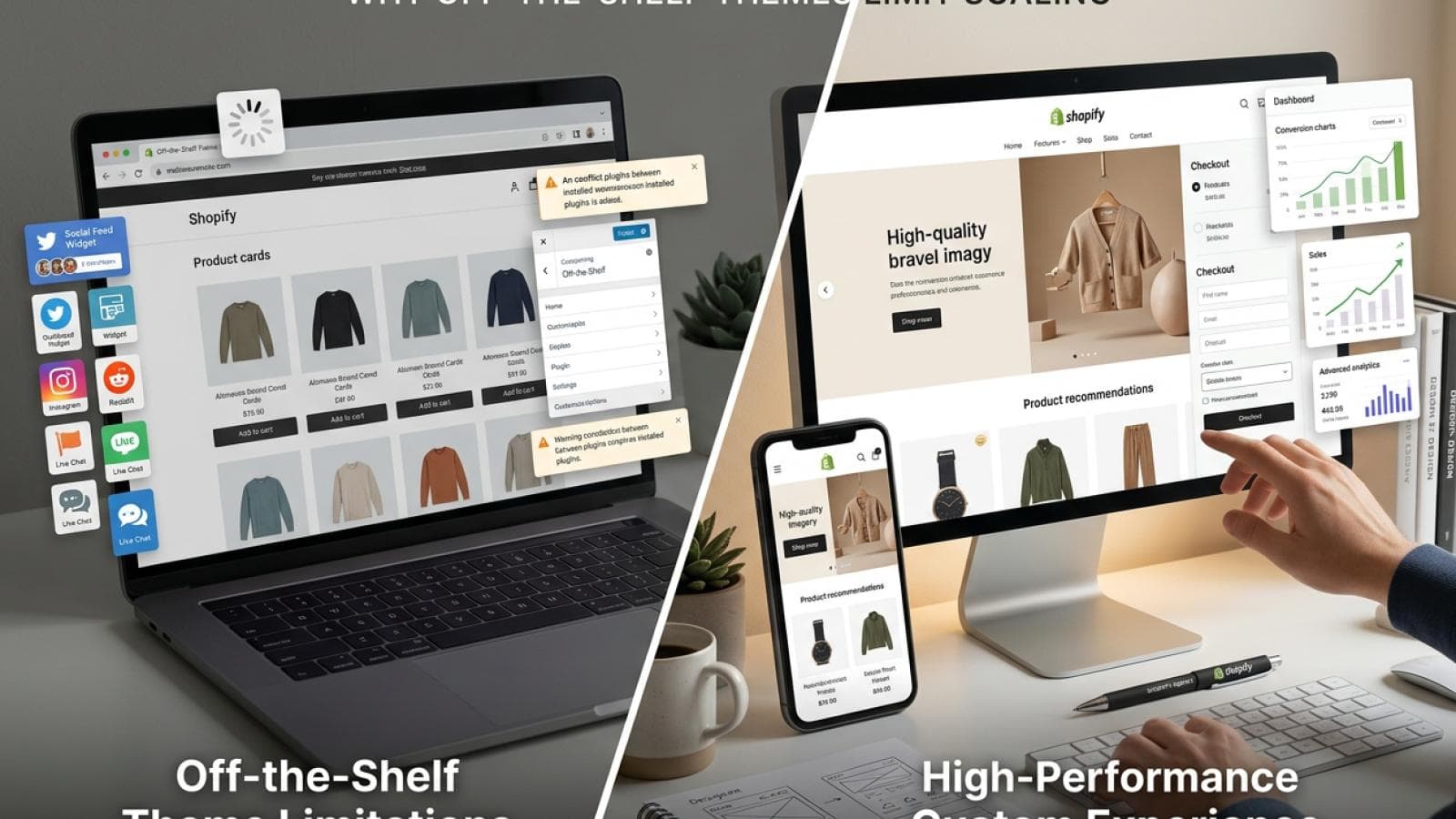
Launching with an off-the-shelf website theme can feel like a smart business move. It is fast, affordable, and often comes with polished demo layouts that make your site look professional right away. For startups and small brands, that convenience is tempting. You can choose a theme, upload your logo, change some colors, add products or service pages, and go live quickly.
Launching with an off-the-shelf website theme can feel like a smart business move. It is fast, affordable, and often comes with polished demo layouts that make your site look professional right away. For startups and small brands, that convenience is tempting. You can choose a theme, upload your logo, change some colors, add products or service pages, and go live quickly.
But what helps you launch quickly does not always help you grow.
As your business expands, your website has to do far more than look decent. It needs to load fast, support SEO, convert visitors into leads or sales, adapt to new offers, handle integrations, and reflect your brand properly. This is where off-the-shelf themes often start to create friction. They may save time in the beginning, but they can quietly limit your ability to scale later.
At Prateeksha, we often see businesses reach a point where their theme-based website is no longer helping growth. Instead, it becomes something they have to work around. The problem is not that themes are always bad. The problem is that most generic themes are built for broad use, while scaling requires precision.
Why Off-the-Shelf Themes Seem Attractive
Off-the-shelf themes are popular for a reason. They offer a low barrier to entry. Compared to a custom-designed website, they are cheaper upfront and faster to deploy. Many also include page builders, sliders, layouts, galleries, blog templates, and plugin compatibility. On the surface, that seems like everything a business could need.
For a simple brochure website or a very early-stage store, this may be enough.
But these themes are made to appeal to thousands of businesses at once. That means they are designed for maximum general use, not for your specific goals, audience, workflow, or conversion path. The more ambitious your business becomes, the more obvious those limitations get.
Themes Are Built for Everyone, Not for Your Brand
A theme marketplace works by selling the same product to many users. Because of that, theme creators try to make their designs flexible enough for multiple industries, business types, and use cases. The result is a one-size-fits-many structure.
The issue is that your business does not need a site built for “many.” It needs one built for your brand.
A growing company usually needs unique landing pages, stronger calls to action, tailored content flow, specific service presentation, better lead funnels, or a custom product experience. A generic theme gives you templates and options, but not true strategic freedom. You end up fitting your brand into someone else’s structure instead of building a structure around your brand.
This often leads to websites that look acceptable but do not feel distinctive. They may resemble many other businesses using similar layouts. In competitive industries, that sameness becomes a real disadvantage. Scaling brands need stronger identity, clearer messaging, and better user experience than a standard template can usually provide.
Performance Issues Start to Hurt Growth
One of the biggest hidden problems with off-the-shelf themes is performance bloat. To make their products attractive, theme developers often pack them with features: animation libraries, visual effects, sliders, multiple header styles, built-in widgets, page builder components, and design presets.
The problem is that even if you use only a small portion of these features, much of the extra code still loads or remains part of the system. This creates heavier pages, slower rendering, and more complexity.
At the beginning, you may not notice. But as your content grows, traffic increases, and users browse on mobile devices, that extra weight starts hurting performance. A slow website impacts bounce rates, reduces conversions, frustrates users, and weakens search performance.
Scaling depends on efficiency. If your site becomes slower every time you add new pages, new apps, or new features, then growth itself starts creating technical problems. That is a bad foundation for any serious business.
SEO Flexibility Becomes Limited
A lot of themes advertise themselves as SEO-friendly. In most cases, that only means they support the basics. Real SEO growth requires far more than a clean-looking page and editable meta fields.
As your business scales, you may need service clusters, location pages, custom content layouts, better schema opportunities, improved internal linking, cleaner code structure, optimized heading hierarchy, and faster page performance. Generic themes are rarely designed with that level of control in mind.
They often produce bloated markup, repetitive structures, or design patterns that make content harder to optimize. When a business wants to create targeted landing pages or build a strong content strategy, the theme’s rigid structure can become a barrier.
SEO is not just about ranking a homepage. It is about creating a scalable content system. If your website theme makes that difficult, your organic growth will eventually slow down.
Customization Gets Messy and Expensive
One of the biggest myths about off-the-shelf themes is that they save money long-term. They often save money only at the beginning.
As soon as you need something beyond the built-in options, the cost starts rising. Maybe you want a custom product layout, a better mobile menu, a unique service page, advanced filters, location-based content, or a more strategic homepage structure. Suddenly, your developer has to override the theme, patch styles, add extra scripts, and work around the existing architecture.
This is where theme-based websites start becoming fragile.
A small design change may affect another section unexpectedly. Plugin updates can create conflicts. A builder update can change layout behavior. Over time, your site becomes harder to manage because it was never built cleanly for your exact needs. It was adapted, stretched, and patched repeatedly.
What looked cheap at the start can turn into ongoing maintenance cost, slower development, and technical debt.
Plugin Dependency Increases Risk
Many off-the-shelf themes depend on plugins for essential functionality. This might seem normal, but as a site grows, plugin dependency can create serious problems. One plugin handles sliders, another handles forms, another handles popups, another handles SEO, another handles performance, another handles reviews, and so on.
Each plugin brings its own scripts, settings, updates, and compatibility risks.
This creates a stack that becomes harder to maintain over time. One update can break styling. One outdated plugin can slow down the site. One conflict can affect core functionality. When your website becomes important to sales and lead generation, that instability is dangerous.
A scalable website should reduce unnecessary dependencies, not multiply them. The more your site relies on disconnected third-party tools just to function well, the harder it becomes to grow with confidence.
User Experience Suffers as the Site Grows
Scaling is not just a technical issue. It is also a user experience issue.
As your business grows, your audience expects more clarity, speed, trust, and ease of use. They want a website that feels polished, intuitive, and built around their needs. Generic themes often start with visual appeal, but they are not always strong in strategic UX.
You may find that the navigation feels generic, page layouts are cluttered, key actions are buried, mobile browsing feels awkward, or product and service journeys are not optimized for conversion. These problems may seem small individually, but together they reduce the effectiveness of the site.
A growing business needs every key page to guide users intentionally. That means the structure, layout, content hierarchy, and interaction design should support business goals. Off-the-shelf themes often emphasize visual flexibility more than conversion logic.
Scaling Requires a Better Foundation
A business that wants to grow sustainably needs a website built like infrastructure, not just decoration. That means clear architecture, lean performance, flexible content systems, better SEO readiness, easier customization, and a user journey designed around conversion.
This does not always mean a business must go fully custom from day one. But it does mean founders should understand the trade-off. Off-the-shelf themes are often good for starting quickly, not for scaling efficiently.
If you know your business will need ongoing SEO, better performance, advanced customization, stronger branding, and a smoother customer journey, investing in the right foundation earlier can save significant time and money later.
When It Is Time to Move Beyond a Theme
A few signs usually indicate that a business has outgrown its off-the-shelf theme:
Your site feels slow even after optimization efforts.
Design changes take too long or break other areas.
Your pages look too similar to competitors.
Your SEO strategy is being limited by template structure.
You keep adding plugins to solve problems the theme should have handled better.
Your website no longer reflects the quality or ambition of your brand.
When these issues start appearing together, the problem is often not a single bug or plugin. It is the foundation itself.
Final Thoughts
Off-the-shelf themes can be useful launch tools, but they are rarely ideal scaling tools. They prioritize broad compatibility over strategic performance, general design over brand distinction, and convenience over long-term flexibility.
That is why businesses that are serious about growth eventually hit a ceiling with them.
A website should not just exist online. It should support visibility, trust, lead generation, conversions, and expansion. When your theme starts limiting any of those, it is time to rethink the approach.
At Prateeksha, we help businesses move beyond generic website limitations and build digital experiences designed for performance, flexibility, and growth. If your current website feels like it is holding your business back, the real issue may not be your marketing. It may be the foundation you started with.