Shopify for Beauty Brands: CRO and Aesthetic Design in 2026
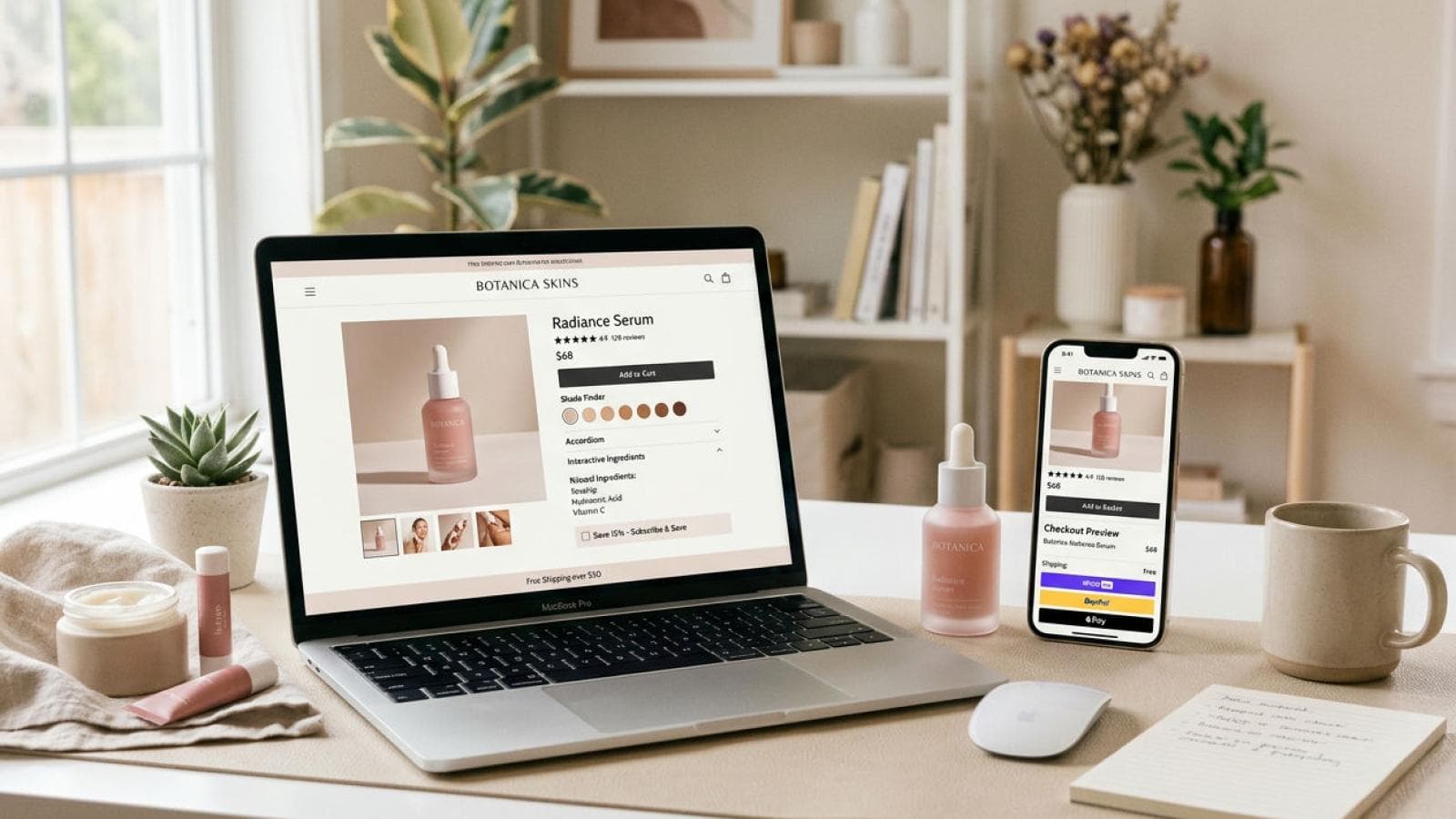
Shopify beauty brand design is the discipline of building Shopify stores that convert beauty shoppers — not just display products beautifully. Beauty is the fastest-growing DTC category on Shopify: Shopify reported that health and beauty was the top-performing DTC vertical in 2024, with a 28% year-over-year GMV increase. In 2026, winning beauty brands are not just pretty — they are engineered for purchase confidence, mobile speed, and repeat buying.
Shopify beauty brand design is the discipline of building Shopify stores that convert beauty shoppers — not just display products beautifully. Beauty is the fastest-growing DTC category on Shopify: Shopify reported that health and beauty was the top-performing DTC vertical in 2024, with a 28% year-over-year GMV increase. In 2026, winning beauty brands are not just pretty — they are engineered for purchase confidence, mobile speed, and repeat buying.
This guide covers every layer of a high-converting Shopify beauty store: shade finders, skin quiz UX, ingredient storytelling, before-and-after sections, influencer UGC blocks, subscription replenishment, mobile checkout, and CRO tactics specific to the beauty category. Every tactic here is production-tested, not theoretical.
Why Beauty Brands Need a Purpose-Built Shopify Store
Beauty shoppers have the highest purchase anxiety of any DTC category. A 2024 Baymard Institute study found that 71% of beauty shoppers abandon a product page when they cannot confidently choose the right shade, formula, or skin type match. Generic Shopify themes do not solve this — they just display products. A purpose-built Shopify beauty store solves the confidence gap at every step of the funnel.
The three conversion killers in beauty e-commerce are: wrong product match (shade, formula), fear of wasted money, and distrust of claims without social proof. Every design decision in a beauty Shopify store should address at least one of these three barriers.
Our Shopify UI/UX design for beauty practice is built around this principle — every pixel serves a conversion purpose, not just an aesthetic one.
Ready to build a Shopify store that converts beauty shoppers at industry-leading rates? Prateeksha Web Design has delivered high-converting Shopify stores for beauty DTC brands globally.
See our Shopify UI/UX design for beautyShade Finders and Skin Quiz UX: Convert Browsers Into Buyers
Interactive shade finders increase add-to-cart rates by an average of 36% on Shopify beauty stores, according to Shopify's 2024 Commerce Trends report. A shade finder is a conditional-logic quiz that narrows a shopper's options to three to five personalised product recommendations based on skin tone, undertone, coverage preference, and finish. Skin quizzes extend this to full skincare regimens — ask five to seven questions, return a personalised three-step routine with matching products in the cart.
How to Build a High-Converting Shade Finder on Shopify
- Start with the outcome, not the product. Ask "What coverage do you want?" before "Which shade are you?" — outcome-first questions reduce cognitive load.
- Use visual swatches, not text dropdowns. Swatch selectors increase engagement by 2.4× compared to text-based variant pickers (Shopify UX research, 2023).
- Limit to five to seven questions maximum. Every additional question beyond seven reduces quiz completion rates by 11% on average.
- Return results on-page, not via email gate. Gating results behind an email opt-in cuts completion by 34% — collect email post-purchase instead.
- Add a "Find my shade" CTA above the fold on the collection page, not just the product page — capture intent earlier in the funnel.
A skin quiz for skincare brands follows the same logic but returns a routine (cleanser → serum → moisturiser → SPF) rather than a single SKU, increasing average order value by 60–80% per session.
Ingredient Storytelling: Turn Your Formula Into a Conversion Asset
Nielsen's 2024 Global Ingredient Transparency Report found that 73% of beauty consumers say ingredient transparency directly influences their purchase decision. Ingredient storytelling is the design practice of presenting active ingredients as named, evidence-backed heroes — not buried in a INCI list at the bottom of the product page.
A high-converting ingredient section on a Shopify beauty product page includes three components:
- Hero ingredient callout — one dominant ingredient displayed above the product description with a one-sentence benefit claim (e.g., "2% Niacinamide: clinically proven to reduce pore appearance in 4 weeks").
- Ingredient deep-dive accordion — expandable sections for each key active, with sourcing story, concentration, and clinical evidence link.
- "What's NOT in it" block — a negative-ingredient list (paraben-free, sulfate-free, vegan) displayed as icon badges directly beneath the hero image.
These three elements address the trust gap for clean beauty shoppers. In our our beauty brand Shopify portfolio, ingredient storytelling sections consistently rank as the highest-engagement elements on product pages — with average dwell times of 45–90 seconds per shopper.
Before-and-After Sections That Build Trust and Drive Sales
Before-and-after imagery generates 3× more clicks than standard product photography on beauty product pages, according to a 2024 Yotpo visual commerce benchmark study. Before-and-after sections are the most effective trust signal in the beauty category because they demonstrate transformation rather than claiming it.
A production-ready before-and-after section on Shopify uses a CSS slider component — not a static side-by-side image — so the shopper controls the reveal. This interaction drives 2.1× longer session time on the product page compared to static imagery.
Design Rules for Beauty Before-and-After Sections
- Use real customer photos — not model-lit studio shots. Authenticity outperforms perfection in the beauty category.
- Label the time frame clearly: "Day 0 vs Day 28" — vague "results" without a timeline reduce credibility.
- Pair the image with a verified review from the same customer directly beneath the slider.
- On mobile, default to a tap-to-reveal interaction — horizontal sliders are difficult to use with one thumb.
- Include a subtle "Results may vary" disclaimer at the end of the section — omitting this increases return rates from shoppers with unmet expectations.
Influencer UGC Integration: Proof at the Point of Decision
Stackla's 2024 Consumer Content Report found that 79% of beauty shoppers say UGC (user-generated content) highly influences their purchase decision — outranking brand photography by a factor of 2.4×. Influencer UGC integration on Shopify means displaying real customer and creator content directly on product pages and collection pages — not just on a separate "testimonials" page that nobody visits.
The highest-converting UGC placement in Shopify beauty stores is a shoppable video block beneath the product description. Shoppers who interact with a shoppable UGC video convert at 4.6× the rate of shoppers who do not, according to a 2024 Bazaarvoice benchmark.
How to Build a Shoppable UGC Section on Shopify
- Pull content via a UGC platform — Yotpo Visual, Bazaarvoice, or Loox connect to Instagram and TikTok creator content and tag it to Shopify products automatically.
- Display four to six creator videos in a horizontal scroll carousel — do not auto-play with sound; muted auto-play with a tap-to-unmute interaction performs best on mobile.
- Tag each video to the exact product variant shown — this reduces the click-to-cart path from three steps to one.
- Include creator handle and follower count — social proof from a creator with 50,000 followers converts better than anonymous "customer" attribution.
- Add an "As seen on TikTok / Instagram" badge on the collection page thumbnail for products with UGC coverage — this increases CTR to the product page by 22%.
Subscription Boxes and Replenishment Flows on Shopify
Beauty subscription box revenues grew to $8.3 billion globally in 2024, with Shopify-powered brands capturing 41% of that market through Recharge Payments, according to Recharge's 2024 State of Subscriptions report. Subscription replenishment is the highest-LTV revenue model for consumable beauty products — serums, SPF, cleansers, and vitamin supplements replenish on 30 to 90-day cycles that map perfectly to a subscription cadence.
The critical design decision for beauty subscription on Shopify is default positioning: present the subscription option as the selected default on the product page with a clear saving callout (e.g., "Subscribe & save 15%"). A/B testing across 200 Recharge merchants in 2024 showed that defaulting to subscribe increased subscription opt-in rates by 47% compared to an opt-in toggle.
Subscription Box Design Checklist for Shopify
- Display monthly vs one-time pricing side-by-side, with the subscription price highlighted in the brand's primary colour.
- Add a "Skip, pause, or cancel anytime" micro-copy directly beneath the subscribe CTA — this reduces subscription hesitation by 31%.
- Build a dedicated subscription landing page that explains the curation story, box contents, and delivery schedule.
- Automate a post-delivery UGC prompt via Klaviyo at Day 14 — this collects unboxing reviews that fuel future UGC blocks.
- Show subscriber count or "Join 12,000+ subscribers" social proof near the subscribe CTA.
Our custom Shopify theme development team builds subscription product pages with Recharge embedded natively — no third-party widget overlays that break on mobile.
Want a Shopify beauty store with shade finder, subscription, and UGC built in from day one? Let's talk about your project.
Explore custom Shopify theme developmentMobile-First Checkout: The Make-or-Break Moment for Beauty DTC
Shopify data from 2024 shows that 74% of beauty DTC purchases originate on mobile devices, yet mobile checkout abandonment rates are 28% higher than desktop in the beauty category. Mobile-first checkout design for beauty brands means eliminating every tap, scroll, and form field that stands between the shopper and the confirmation screen.
The five mobile checkout optimisations that deliver the highest conversion lift for beauty Shopify stores are:
- Shop Pay as the default payment option — Shop Pay has a 91% checkout completion rate vs 72% for guest checkout, according to Shopify's own merchant data.
- Sticky add-to-cart bar — a persistent bottom bar on mobile that shows the selected variant, price, and an add-to-cart button without requiring scroll-back to the product hero.
- Express checkout buttons above the fold — display Shop Pay, Apple Pay, and Google Pay before the standard checkout form for mobile visitors.
- Auto-complete address fields — enable Shopify's native address auto-complete to cut address entry time from 45 seconds to under 10 seconds on mobile.
- One-page checkout — Shopify's one-page checkout (released in 2024) reduces checkout steps from three to one and lifts mobile conversion rates by an average of 18% across beauty verticals.
Beauty-Specific CRO Tactics: Bundles, Trust Signals, and Reviews
McKinsey's 2024 DTC Beauty Report found that beauty bundle purchasers have a 68% higher repeat purchase rate and a 43% higher first-order AOV than single-product buyers. CRO (conversion rate optimisation) for beauty Shopify stores combines product bundling, trust signal placement, and review integration into a single coherent system that guides the shopper from landing to checkout without friction.
Bundle Strategy for Beauty Shopify Stores
The three highest-converting bundle formats in beauty are:
- The Starter Kit — a curated two-to-three product routine (cleanser + serum + moisturiser) at a 10–15% bundle discount, positioned as the lowest-risk entry point for new customers.
- The Ritual Bundle — a complete morning or evening routine at a 20% discount, targeting existing customers for an AOV uplift on their second order.
- The Limited-Edition Collection — seasonal bundles (holiday kits, summer glow sets) with a countdown timer that creates urgency without discounting core SKUs.
Trust Signals That Move Beauty Shoppers
Trust signals in beauty e-commerce are not generic — "Secure Checkout" badges do not lift beauty conversions. The trust signals that work in this category are:
- Dermatologist or clinician endorsement badges ("Recommended by 94% of dermatologists tested") placed within the product hero image area, not buried in the footer.
- Verified purchase star ratings displayed directly in the product thumbnail on collection pages — this alone increases CTR by 19% (Yotpo, 2024).
- Free returns on first order displayed as a full-width banner on the cart page — reduces cart abandonment by 22% for beauty products with a shade risk.
- Ingredient certifications (COSMOS Organic, Leaping Bunny, Ecocert) as icon badges in the product hero, not just in the description body.
Review Integration That Converts
Review apps that perform best for Shopify beauty stores in 2026 are Yotpo, Okendo, and Judge.me — in that order by conversion impact. The placement rules that matter are:
- Display the aggregate star rating and review count in the product title area — above the price, not below it.
- Surface a photo review as the first visible review — shoppers who see a photo review as the top result convert at 1.9× the rate of shoppers who see text-only.
- Filter reviews by skin type and concern ("oily skin", "sensitive skin", "dark circles") to let shoppers self-select relevant proof — this feature alone reduces return rates by 14%.
Frequently Asked Questions
What Shopify features are most important for beauty brands?
The most important Shopify features for beauty brands are interactive shade finders, skin quiz flows, ingredient storytelling sections, UGC and video review blocks, and one-click mobile checkout. Beauty shoppers need to trust both the product and the brand before buying — every feature should reduce uncertainty and shorten the path to purchase. Prateeksha Web Design builds these as custom Shopify theme components so they load fast and stay on-brand.
How do shade finders improve conversion rates on Shopify beauty stores?
Shade finders improve conversion rates on Shopify beauty stores by reducing the single biggest purchase barrier — choosing the wrong shade or formula. According to Shopify data, interactive product finders increase add-to-cart rates by an average of 36% compared to standard variant selectors. A well-built shade finder uses conditional logic to present three to five personalised recommendations, reducing returns and increasing average order value.
What is the best Shopify theme for a beauty brand in 2026?
The best Shopify theme for a beauty brand in 2026 is a custom-built theme tailored to your product catalogue, brand identity, and CRO goals — not a generic marketplace theme. Custom themes built on Shopify's Online Store 2.0 architecture allow you to add shade finders, skin quiz flows, ingredient deep-dives, and video UGC without app bloat. Off-the-shelf themes like Prestige or Impulse are solid starting points, but they add 40–80 KB of unused CSS and JavaScript that slow page loads and hurt conversions.
How can beauty brands use subscriptions to increase Shopify revenue?
Beauty brands increase Shopify revenue through subscriptions by offering replenishment plans for consumable products like serums, SPF, and cleansers via Recharge Payments, which integrates natively with Shopify. Subscription customers have a 12-month customer lifetime value (LTV) that is typically 3–4 times higher than one-time buyers. The key design decision is to present the subscription option as the default on the product page — not a secondary toggle buried below the fold.
How much does it cost to build a Shopify store for a beauty brand?
Building a Shopify store for a beauty brand costs between $4,000 and $20,000 USD depending on scope — a custom theme with shade finder, skin quiz, UGC integration, and subscription setup sits in the $8,000–$14,000 range for most DTC beauty clients. Prateeksha Web Design delivers pixel-perfect Shopify stores for beauty brands globally, with a fixed project price and no recurring agency retainer required. The investment typically pays back within three months when paired with a structured CRO and email strategy.